The heartless have no heart
The Most Precious of CargoesThe heartless have no heart is a slogan that turns persecution into a claim that its targets are less than human. Repeated by the Poor Woodcutter and his companions, it is tested against the living child they condemn: her need for food and care, and the tenderness her presence awakens, expose the slogan’s falsehood. Its reversal also shifts the story’s emphasis from explanations of divine favor toward acts of human responsibility.
The Slogan and Its Setting
The Poor Woodcutter’s wife’s longing for a child begins in prayer. She appeals to heaven and to the natural world, asking for a child and, as years pass, for relief from hunger and cold. This language of appeal establishes a contrast that recurs when the infant arrives: the wife interprets the child as entrusted to her by the gods of the cargo train, while the practical means of keeping the child alive must come from people willing to help.
The slogan’s social force becomes clear in the Poor Woodcutter’s words and in the talk of his fellow workers. They repeat that the heartless are without hearts, liken them to stray dogs, and blame them for the trains and the hardships of wartime. The group’s drinking songs turn that accusation into a call for extermination, while another refrain imagines knives used against the heartless. These are not merely private opinions: the workers attribute them to the Hunters of the Heartless and the invaders, suggesting how persecution is reinforced through slogans taught and repeated among ordinary people.
The Child as a Test of the Claim
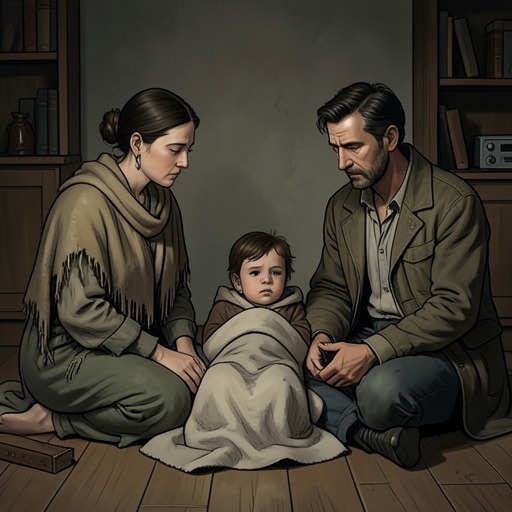
The infant’s arrival makes the slogan concrete rather than abstract. The Poor Woodcutter’s wife feeds her with cooking water and a little kasha, first offering food on her finger when the child will not take it from a spoon. As the infant quiets in her arms, the wife sings to her and calls her a child of her own. The scene gives the language of kinship a lived basis: care is not a claim about what a group deserves, but work undertaken for a particular, vulnerable child.
When the wife asks for help obtaining milk, the Poor Woodcutter initially dismisses the child’s death as unimportant and says another could be made. The wife answers that she is no longer of an age to have another child and that this one was entrusted to her. Later, she insists that helping the infant live may bring the gods’ gratitude and protection. He rejects that reasoning, but his resistance does not settle the question of the child’s worth; it shows how thoroughly the slogan has shaped his first response.
Repetition and Reversal
The Poor Woodcutter’s encounter with the child unsettles the words he has repeated. Although he continues to recite the slogans, contact with her and the sight of her reaching toward him awaken a sense of tenderness and recognition. His conduct and speech pull in opposite directions: he says he does not want to look at or feed her, yet struggles against the impulse to take her into his arms. The narrative makes that contradiction the point at which the slogan begins to fail.
The conflict returns among the woodcutters. As the others toast the death of the heartless, the Poor Woodcutter remains silent at first. He then declares that the heartless have a heart, publicly breaking with the rhetoric he had echoed. The declaration has a consequence in his own life: he leaves his companions and hurries home, frightened by what he has said but also relieved and proud to have ended his submission and silence. The repeated slogan is thus answered not by an abstract argument, but by a changed allegiance expressed aloud.
Human Responsibility and the Ending
The story’s later events further qualify the belief that the child’s survival is guaranteed by divine intervention. The Man with the Goat and Shattered Face shelters the mother and child and arranges for a goat to nurse the girl. After his death, the Poor Woodcutter’s wife covers his body with blossoming branches and prays for his peace. She then credits the child’s survival to the hand that dropped her from the train and to the righteousness of the man with the rifle and goat, rather than to the gods of the train, whom she no longer trusts.
Against this ending, The heartless have no heart reads as both a weapon and a claim vulnerable to evidence. Its repetition turns people into targets, but the child’s dependence, the Poor Woodcutter’s changed response, and the Man with the Goat and Shattered Face’s protection all reveal human capacities the slogan denies. The story does not replace one easy account of providence with another: it leaves the wife’s prayers and former faith visible while placing the decisive acts of survival in human hands.